A Treasury working paper from May last year released under Freedom of Information to The Guardian has estimated the impact of the Morrison Government’s failed Job Ready Graduates (JRG) scheme on student debt and repayments.
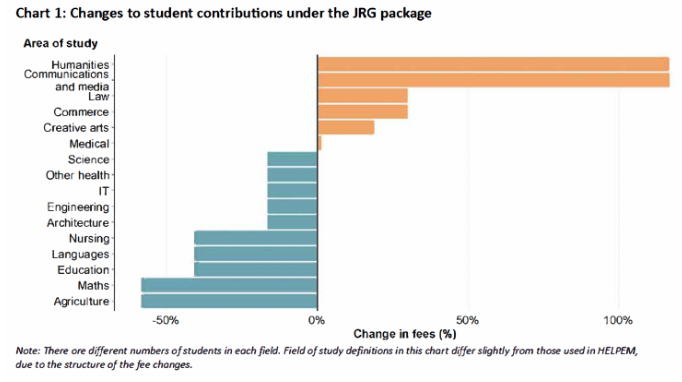
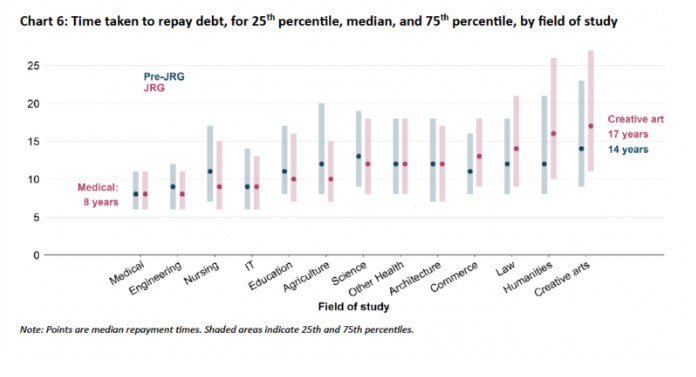
The paper finds that JRG, which has now been in place for longer under the Albanese Labor Government despite promises for reform, increases fees in fields where students tend to have lower earnings and blows out total debt and repayment times in impacted disciplines.
It says, “[i]n both creative arts and humanities, we expect it to take more than 25 years for three-quarters of students in each field to repay their bachelor debt.”
JRG is saddling students in some disciplines with higher debts that take longer to repay, “[m]any students in these disciplines may continue to make repayments toward their debt in their late 30's, 40's, and beyond.”
ACT Independent Senator David Pocock said the Treasury working paper underscores the urgency of reforming JRG.
“Last week the senate Education and Employment committee heard evidence from the Department of Education that they hadn’t undertaken any modelling on the impacts of JRG, clearly Treasury has and the results are deeply concerning,” Senator Pocock said.
“Labor is about to tick over four full years in office. During that time tens of thousands of students have racked up debts that will take them decades to repay.
“This unfair burden of higher student debt in lower income professions will massively impact graduates' lives, making it even harder to buy a home, start a family, travel: realise so many of the different dreams and ambitions young people hold.
“If the Albanese Government is serious about doing more on intergenerational equity, then reforming JRG has to be an urgent priority. JRG has now been in place for longer under the Albanese Government than the Morrison Government.”
The Treasury paper highlighted the disparity JRG creates between different disciplines with “[more than twice as many graduates would leave university with debts under $20,000 under JRG fees, and the share who leave university with debts of $50,000 would increase by 70 per cent.”
Analysis by Innovative Research Universities has also highlighted the impact JRG is having on students from low socioeconomic backgrounds, deterring enrolment in disciplines that have become more expensive for students under JRG. They found that “total domestic Bachelor degree commencements declined by 3.5% between 2020-2024, but low SES student commencements were down 9.8% compared with a 2.2% decline for non-low SES students. For courses with the highest student contribution rates under the JRG policy (including Humanities, Commerce and Law), low SES commencements declined 19.7%.”
The Treasury paper quantifies this increase in debt under JRG.
“Under the JRG scenario, law graduates have the highest levels of debt, owing to high student contribution fees, the long length of law degrees, and because many students who study law take the course as part of a double degree. Often, humanities or commerce is the second field in these double degrees, both of which also attract the highest student contribution rate. Under the JRG scenario, a substantial fraction of law graduates accrue over $75,000 worth of HECS/HELP.”